MEDIA AND SCAPEGOATING
GLOSSARY 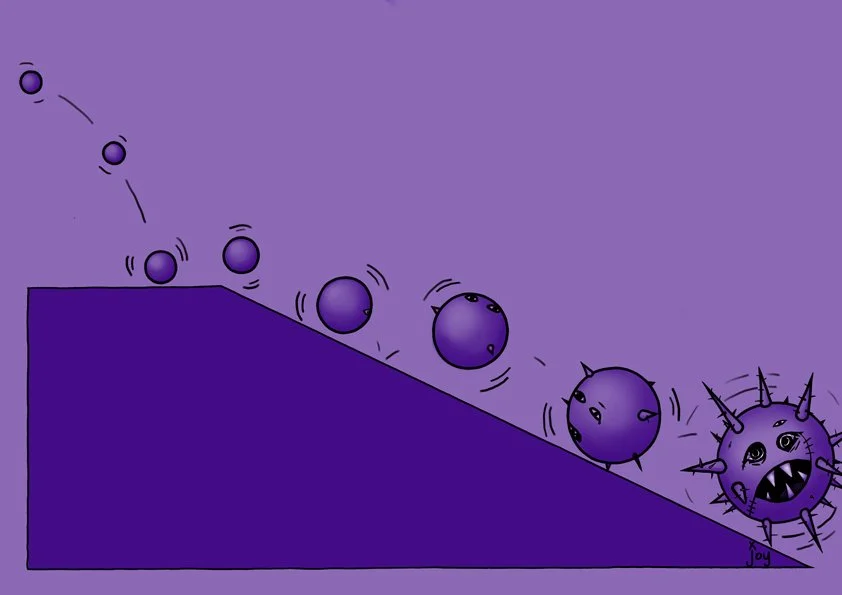
The glossary below presents the common narratives and linguistic tools of scapegoating covered in our trainings.
RECURRING NARRATIVES OF SCAPEGOATING
Scapegoating creates a sharp “us vs. them” division between two or more groups. For this to happen, stories have to be told about “us” and “them.”
History reveals that while specific stories may vary across contexts, the underlying narratives follow the same script regardless of time and place.
The following glossary explains these narratives that were identified by political scientist Jonathan Leader Maynard:
Narratives about “Them”
THREAT CONSTRUCTION: narratives depict an entire group as an existential threat to “us.”
GUILT ATTRIBUTION/COLLECTIVE BLAME: narratives blame an entire group for the actions of a few, portraying an entire group as “guilty” or responsible for harms against our own group.
DEHUMANIZATION/DE-IDENTIFICATION: Narratives portray an entire group of people as less than human or essentially different from “us.”
Narratives about “Us”
VALORIZATION OF VIOLENCE: narratives describe violence and its perpetrators as virtuous and often also link violence to ideas about masculinity or being a “good man” through protecting “our women and children.”
DESTRUCTION OF ALTERNATIVES: narratives depict violence as the only option or the only solution to the problem.
FUTURE ORIENTATION: narratives assert that a better, more prosperous future is only possible through cruelty and violence.
RECURRING LANGUAGE TOOLS OF SCAPEGOATING
Scapegoating narratives can only be built with the help of particular language tools. Like the narratives themselves, these language tools are universal.
Below is the glossary of the key linguistic building blocks of scapegoating narratives.
SUPERLABEL: a group name that strips group members of complexity so that only a few very positive or very negative traits come to one’s mind when encountering the name.
FRAMING: consistently using a very limited vocabulary to describe a group so that its name can transform from an ordinary label to a superlabel.
WE-ING AND THEM-ING: employing second- and third person plural pronouns and/or corresponding verb conjugations to create a categorical and hostile separation between groups of people.
OUR-ING: emphasizing what belongs to a group to evoke intense fear that the people, places, and values most cherished by its members are threatened by another group. Our-ing is also used to forcefully confiscate—first through language and then in reality—actual resources that were meant to be shared or the personal belongings of members of another group.
FALSE DILEMMA FALLACY: claiming that members of a group either engage in aggression and violence against another group or jeopardize the survival of their own group.
SLIPPERY SLOPE FALLACY: suggesting that if a certain rights-curtailing course of action is not taken against another group in the present, one’s own group will suffer radical, severe, and disastrous consequences in the future.
VICTIM-VICTIMIZER REVERSAL: accusing another group of the very crimes that one intends to commit or is committing.
WAR METAPHORS: claiming that members of another group are soldiers of a powerful foreign army that aims to violently seize control of the countries and communities of one’s own group.
NATURAL DISASTER METAPHORS: using terms like “flood,” “tsunami”, or “wave” to depict a group moving from one location to another.
DISGUST, DISEASE AND HORROR METAPHORS: claiming that members of a group are “animals”, “pests,” “reptiles,” “parasites,” “disease,” “filth,” “demons,” “dreaded beings,” or alike.